Helicon (1,749m) [P-1288]
Summited On: March 25, 2025
Region: Phocis, Central Greece, Greece.
Rating: ★★★☆☆
Partners: Terry Raissi
Overview
Trip Report
Prologue
With the winter quickly winding down here in Greece following a disappointing mid-March snowfall, we decided to start our 2025 hiking season early. Luck was on our side as the 25th of March, the commemoration the Greek Revolution meant a bank holiday, and what better way to celebrate Greece's 204th 'birthday' than getting really high. Our target, the mythical mountain of Helicon (1,749m) in Boeotia, Central Greece, chosen for reasons that will soon become clear.
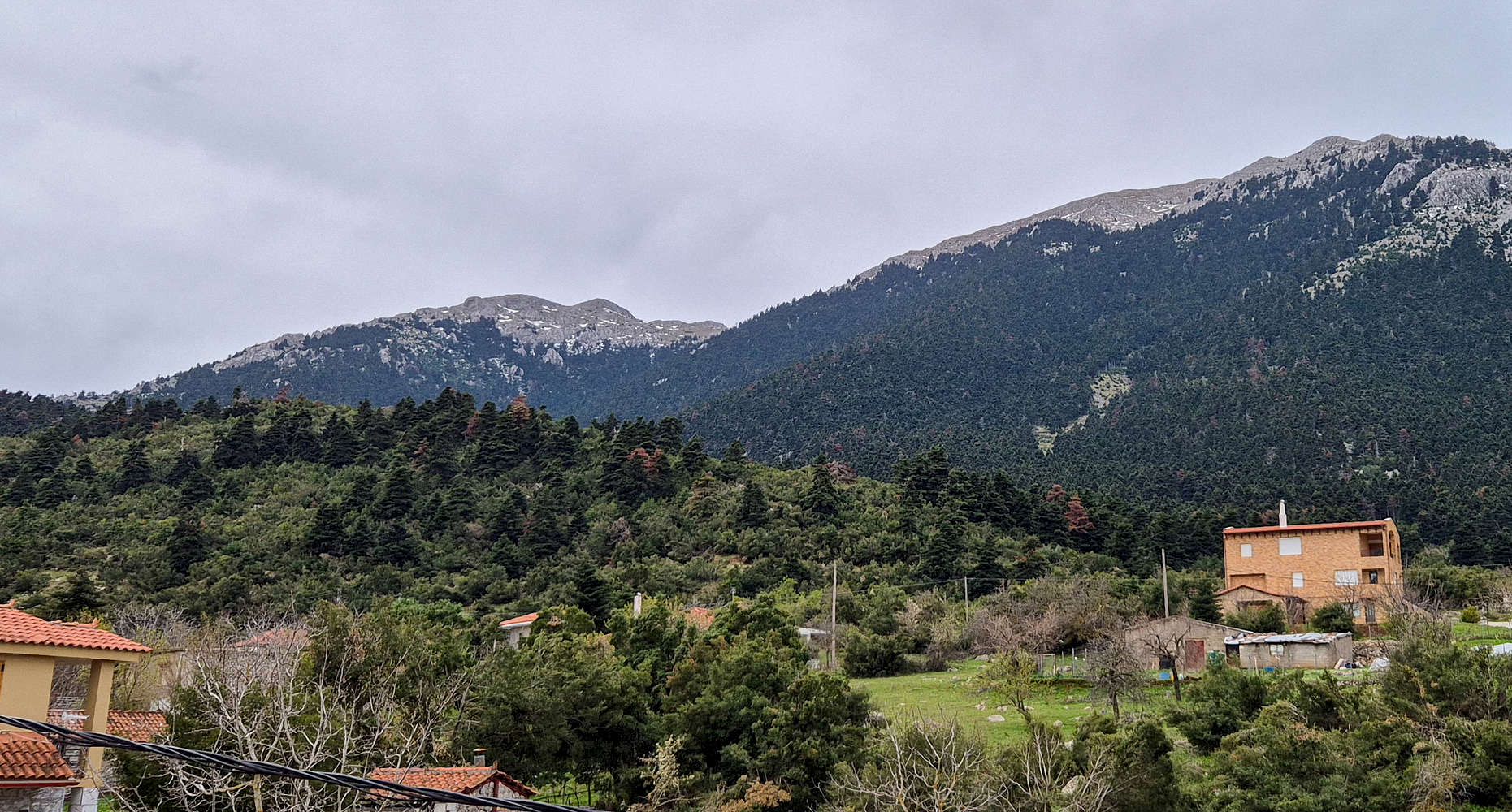
Helicon N Face as seen from Agia Anna.
Helicon (1,749m) offers a compelling early season objective, being high enough to benefit from the recent snowfall, but low (and south) enough to be un-hikeable during the hot months. Less than two (2) hours from Central Athens, access is easy, but that is only up to the trailhead, from which the real fun begins. The E22 trail tackling Helicon's (1,749m) highest summit Palaiovouna offers an excellent hike of 1,000m gain through three types of terrain. While the mountains’ peripheral peaks are littered with wind turbines, Palaiovouna has remained relatively undeveloped, hosting a large 'old growth' forest of Fir, and dominated by limestone which over time has given way to interesting formations. Tackling the North side, the E22 trail, over its 8km, crosses the fir forest, then through a steep slope accesses the East ridge, which must be traversed until the labyrinth-like Bauxite mining pits are reached. From there the trail makes a direct attack on the rocky summit cone. According to our research we expected a time to summit of around three and a half (3:30) hours and a total trip time of around six (6) hours.
Part I: Forest of the Muses
Arriving at the windy, dark, and empty streets of Agia Anna at 19:00 on a Monday maintained an air of mystery about the surrounding terrain, with the forests and bald craggy summits hidden in the night, just the red lights of the wind turbines markers of invisible ridges. In that moment we were surrounded by more than rock, around us was also the mythos of thousand years of civilization on the Boetian plains which inevitably made this mountain its center of life and mysticism. The karstic geology fostered an environment of abundance driven by water and extending to vegetation such as olive, and wildlife such as deer and boar. It is therefore little wonder that the mountain formed close association with classical Hellenistic myth, through it being considered the home of the Muses. The Muses - generally thought to be nine (9) - are the inspirational goddesses of literature and science, providing patronage to different aspects such as (Clio) history, (Urania) astronomy, (Euterpe) flute, but also (Meplopmene) tragedy, and (Thalia) comedy. Which one were we to meet tomorrow?
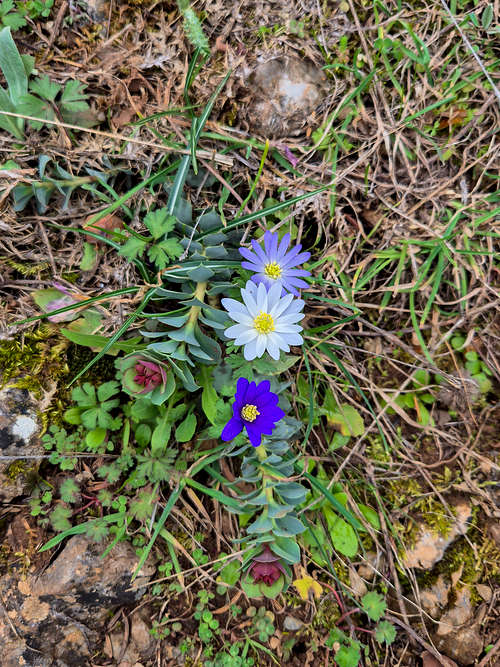
Flowers growing in the forest.
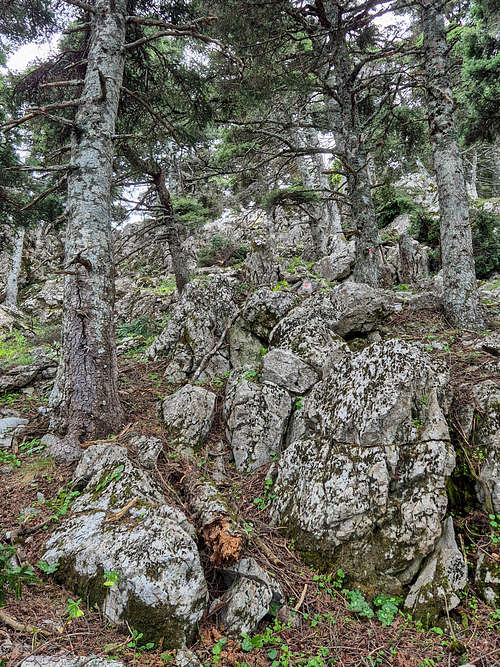
The limestone begins higher up.
At 08:00 the howling winds of the previous night had subsided, and the wind turbines stood like sentinels protecting the plateau of Ag Anna in the soft light. Starting from our b&b at 700m we walked through the village and made it to the forestry road and the woods within a brisk 15 minutes. Here on the lower slopes, the forest is a mix of fir and pine, old and tall, creating a dark canopy under which we will be spending the next hour. At this elevation the forest is a hive of activity with the song of robins serenading us on this unusually warm and humid morning, one would think Euterpe was at work. Making our way up towards 850m the terrain begins to steepen as large bands of limestone lay about and thinner firs cast their shadow on the trail. The route approaches a ridge, which is always just out of reach, until at a clearing it quickly comes into view just above. Here recent rains, snow, and powerful winds have destroyed many of the firs, some over 20 feet tall, and have bent and snapped them like toothpicks. With the temperature rising a small shower passes us overhead, forcing us to quickly retreat under one of the giants, and here the first feeling of doubt quickly crept in.
We were nowhere near breaking into the alpine
The morning was meant to start earlier, in the original plans by as much as two hours, and now it was already 09:30, drizzling, and we were nowhere near breaking into the alpine and laying eyes on the traverse. I silently wondered whether we were meant to stand on the summit, or whether we would be better off turning around now, and enjoying some meze at a local place back in the village; I did not entertain the notion for long as the drizzle subsided, the alpine could not be too far.
Part II: Fortress in the Sky
Soon after pushing through some even steeper terrain we broke over the NE ridge at about 1,000m elevation where the mountain finally indulged us with some views to the northeast. Climbing a small outcrop next to the trail I looked at Motsara (1,525m) of Helicon (1,749m) with its wind turbines, marble quarry, and limestone ridge, a striking reminder of what was waiting for us beyond the reaches of now ever thinning forest. No more than 15 minutes later the trail led us under the northeast face of sheer limestone which marks the start of the ridge, imposing, smooth, and steep, it makes for an exciting scrambling objective. We had yet to break out into the alpine and lay eyes on the mysterious traverse, a section of trail with low grade which covers nearly 2km across the eastern ridge. We continued up the steep slope through thinning rows of trees and began to break into the alpine, we were at 1,350m, getting a clear view into Palaiovouna Ravine, more than 400m deep, and our starting point Ag. Anna, 650m below. We were just over two and a half hours into the jaunt and decided to take a break. From here the traverse could be 'drawn out' but remained hidden behind the few trees which held onto the steep side of the mountain, only a few meters below the outcrops of the ridge-top. Here doubt crept back in like an unwanted guest, with our planned summit time of 12:00 seeming impossible and the pass which would lead us to the summit looking farther than anticipated. The unknowns about the traverse were not helping either, the terrain is steep and occasional snow patches of some size had already made their appearance, and while my bag was weighed by an ice axe, I was not excited with the prospect of using it. Either way, it was worth attempting, we could keep pushing for at least one more hour and still have time to enjoy meze.
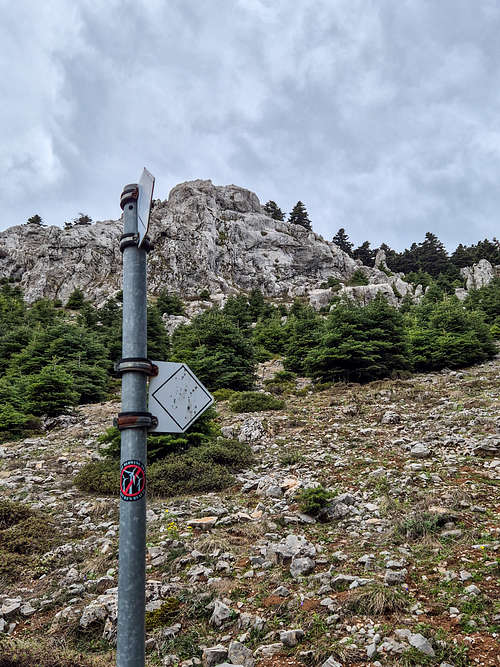
Our first look of the limestone ridge.
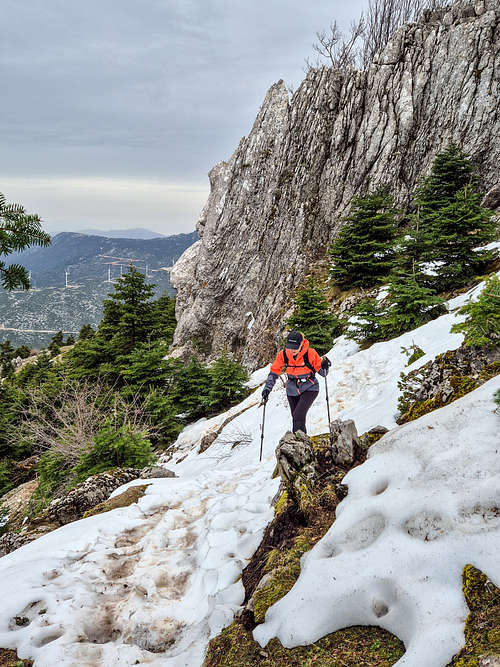
Terry on the snowy traverse.
Driven by little more than curiosity and nearly 700m above our starting point we headed up the steep slope overlooking the ravine and covering the final 100m of elevation to the start of the traverse. Here at 1,400m the limestone, which has been graciously hosting us for close to three (3) hours made its presence known, inviting us up a narrow and exposed trail. On the left was our host, sculpted into aggressive forms and intermitted by steep couloirs filled with scree, along with some brave trees, and plenty of snow patches. On the right were sparse firs, often holding up the trail itself with their roots, and beyond them, nothing but the steep slopes of Palaiovouna Ravine. Here upon stepping into the first deep snow patch I made a disturbing realization, my left gaiter strap had been cut clean. The cut seemed to have been caused by some sharp piece of limestone protruding from the trail, an acceptable sacrifice I thought. While the traverse was narrow and navigating it was hard, our fast pace reignited confidence into the endeavor. As we finally left the forest behind us at around 1,500m the alpine welcomed us with its beautiful, sculpted figures. Around 11:15 we finished the traverse and laid eyes into the lower mine pits, the deep scars of Bauxite, and the meandering dirt roads rising above them. Here in a now depleted Bauxite deposit we sat for a break, next to us a single fir in the deep snow patch, a solemn sight in the deafening silence of the alpine.
Part III: Over the Rainbow
As an avid Google Earth user, I always try to get a feeling for the terrain and standing at the lower mining pit I felt utter dread realizing that the elevation profile here was nothing like what was expected. I stayed silent on this point and hoped that somehow, whatever miracle had pushed us to speed the traverse would continue and that the summit marker was about an hours hike away, I put on my jacket and continued. Moving through the highly weathered mine pits, and connecting the winding roads on a south-westerly course, we were rewarded with the beautiful geology of the massive outcrops of limestone hanging from the summit cone. Pressing towards the upper reaches of the pits and close to the last mining building left we ran into a high quality Bauxite heap. The ore, widely mined in Greece and used for aluminium, is red in colour and contains metals of varying vibrance. Here fist sized ores with large iridescent surfaces were plentiful and made for a curious discovery at 1,600m. The show was soon stolen, however, by the view of the fallen tower which marks the summit, its red and white paint contrasting the whitened rocks beckoning us to reach it. Glancing a hundred meters below, among the mining refuse, two dark figures and their golden four-legged companion were faithfully making their way up too, the first other party we saw on the mountain. The last 100m had us deviate to the North and tackling a steep couloir before meeting with the actual trail again under the summit. At this point the we were served with a view south and across the gloomy Corinthian Gulf from Geraneia to Chelmos, and just below us to the Bay of Alyki. Above the couloir the going was painless and with the clock ticking just past 12:35 we reached the summit point and the destroyed infrastructure which surrounds it at 1,749m. Exactly 1,049m above our starting point.
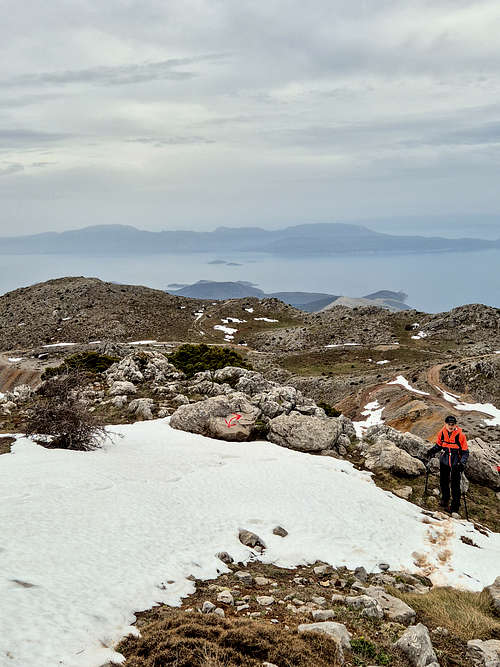
Views above the Corinthian Gulf.
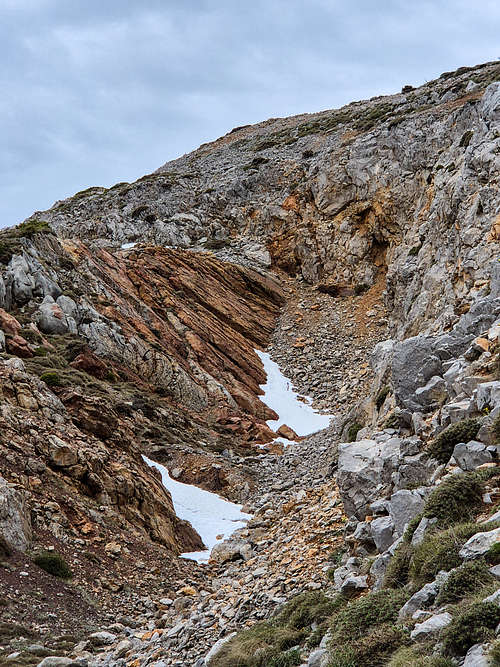
Depleted Bauxite deposit.
Here on the sun-bleached rocks of the summit we sheltered behind a small wind-wall and shared a little bottle of rakomelo (raki - Greek distilled white alcohol - with honey), while I enjoyed my summit cigarette. Soon, the large face of a Golden Retriever and the sound of the large bell on his collar alerted us to the arrival of that other party to summit. Following the usual pleasantries, the two local old men introduced us to their route, a steeper and more dangerous approach from the backside of the East ridge and spoke in no uncertain terms about the wind turbine installations littering nearby peaks and ridges. They pointed out the southwest ridge of the massif, where the twin peaks of Tsiveri (1,560m) lie, offering an hour long, 1,000m exposure traverse; a new access road had just been cut and the wind turbine base markers set. They spoke in a defensive manner, and noted the damage already done by the Bauxite mines below, as if the mountain was an injured beast made to perform for a final time. Before heading down, we took group photos of each other, mementos of our visit.
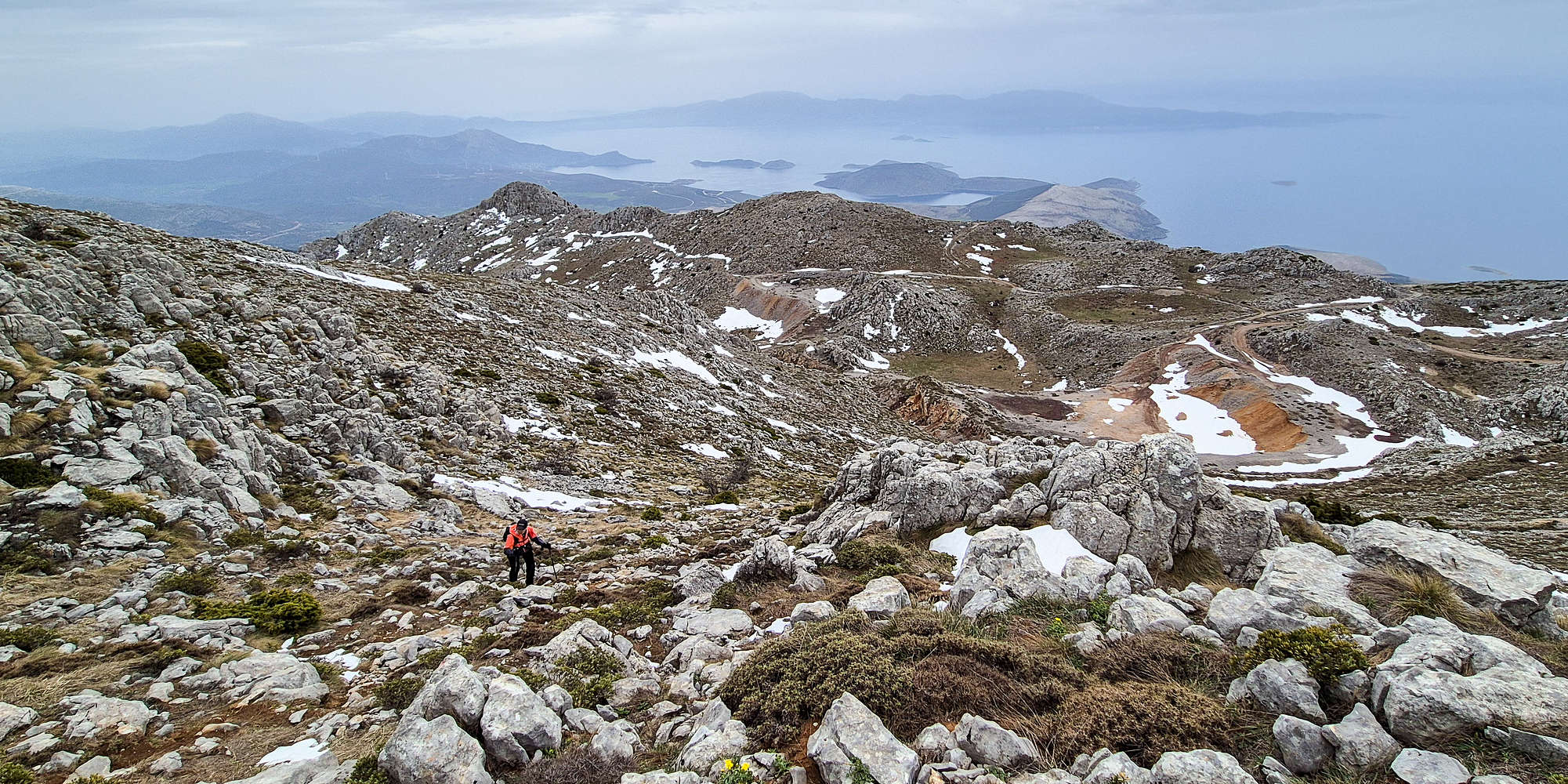
Hiking above the silent Corinthian Gulf.
Part IV: The Limestone Strikes Back
It must have been less than five (5) minutes into the return, when stepping into a thin snow patch my left heel felt cold and wet. Wearing gaiters, I was curious, and took another step, confirming that the damage was at the bottom. Stopping at the nearest rock and inspecting the boots, seldomly used, but chosen for being waterproof, I discovered that the left boots sole was falling apart at the heel. The two men curiously joined to help us out with repairing my polymerized boot, and when my ski strap failed at holding it together, one of them offered me zip ties. He dictated the repair, using one around the arch, and one around the heel using the loop at the back, holding the sole together sufficiently. Although concerned, the speedy repair and much needed assistance kept our spirits high.
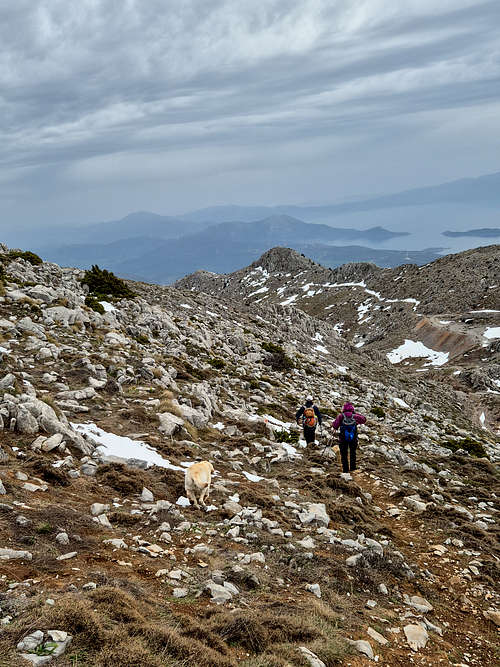
Mysterious locals & their dog.
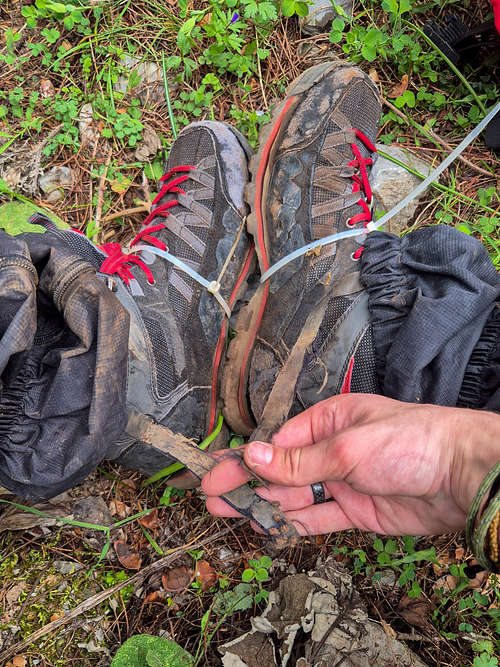
My ruined boots & gaiters.
Looking at the affected boot no more than ten (10) minutes later I grimly discovered that the heel-tie was cut again from the sharp limestone of the mountain. The destruction of the gaiters was acceptable, but the worsening of this situation, not so much. Our gracious companions curiously joined us again for this repair, offering a third zip tie, confounded by the straightness of the cut made by the terrain into the plastic. Bending down to fix the heel for the second time, the man who had helped, sternly cautioned me to "keep [the zip tie] for later, just in case". They then proceeded to speed up, dropping away into a scree not to be seen again.
Each few steps required a careful examination of the boots, noting the deteriorating condition of each
Visibly shaken now, and smoking a cigarette in the windless mine pits we hastened our pace, heeding the mysterious words of the now far gone party of locals, and descended to begin the traverse. Here the boots would be put to test, dealing with sharp rocks, a narrow trail, and the ruinous snow. The snow was what had sped up their destruction beyond breaking point due to the rapid change of temperature at each snowy and slippery step. Knowing our speed through this section and dreaming of the muddy trail of the forest below, it was time to bid farewell and descend. While the going was quick, each few steps required a careful examination of the boots, noting the deteriorating condition of each. Soon the sole of the right boot followed suit and crumbled. Without thinking about the zip tie which lay in my pocket, I used the still functional right gaiter strap and pressed on. We soon crossed the hour mark on the return and broke out of the traverse and into the slopes. The dangerous condition of my shoes and the lateness of the hour cut our break short, and we continued down and into the forest.
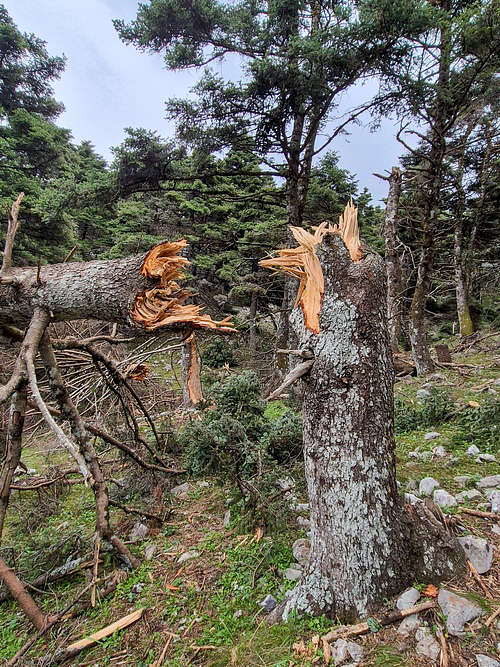
A tree snapped clean.
Going was good as we moved down the slope, onto the ridge, and then into the large couloir, the weather had remained stable and the trail conditions improved, with less snow and sharp rocks. Nearing the dense forest, now eerily quiet in the gloomy afternoon and making our way down bands of limestone, the right gaiter strap, holding my right boot together, was now also sliced by the rocks. The mountain was not ready to let us go yet, and we had more than three (3) kilometers left to walk through the muddy forest. I sat down on a rock, near some broken trees to repair it. Searching through my pockets for the zip tie I was left by my companion for a moment of reflection, but little other than the thought of getting down to the forestry road crossed my mind. I was not going to experiment with the placing and fastened the zip tie dead centre on the arch of my right boot. I tightened both zip ties just enough to feel them squeezing my feet and cutting my circulation and made my way down, returning to the hotel after just over seven (7) hours and five (5) minutes.
Epilogue
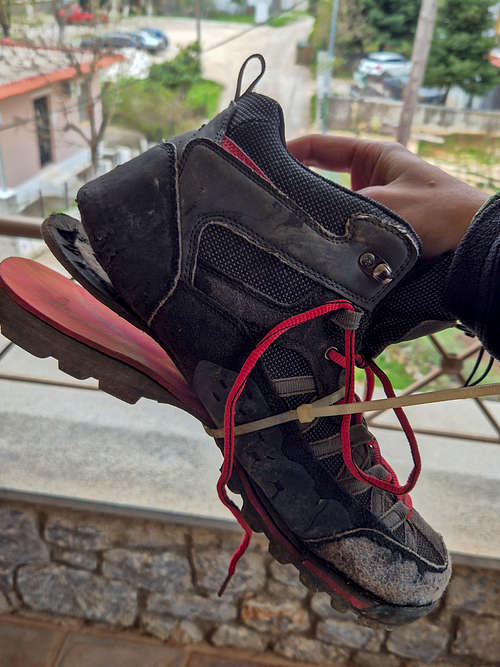
The boot aftermath.
Sitting down in Athens not more than 48 hours later and typing this out my mind centers to the unlikely scenario of having met that party of helpful locals, more so even, the double luck on the timing. That is, we started later, such that we accidentally ran into the other party, and my shoes began to break down while we were with them. While we had rope and tape capable of solving the problem, to some extent, I dread to consider what would have been the outcome of the hike if that was the case. I am quite certain my feet would feel significantly worse. So what should one carry to avoid such a situation? A good shoe repair kit should contain, several zip ties of various sizes, "american-style" duct tape, and potentially glue - depending on temperature. I will be sure to keep such a repair keep in my hiking bag at all times going forward. While the beautiful song of Euterpe is now drowned by the cacophony of the city, my mind unwillingly reflects on other Muses, and not the one of drama, comedy, or even the one which beckons us to reach summits, but Clio, she who inspires us to write. That is to record history in general, for the sake of it, and in this case to do so on this website. I deeply wanted to write a new trip report again after nearly a decade of unrecorded experiences in the mountains, and was surprised to be 'handed' (or walked) a great story, and as is usually the case, one far removed from what I expected on that morning.